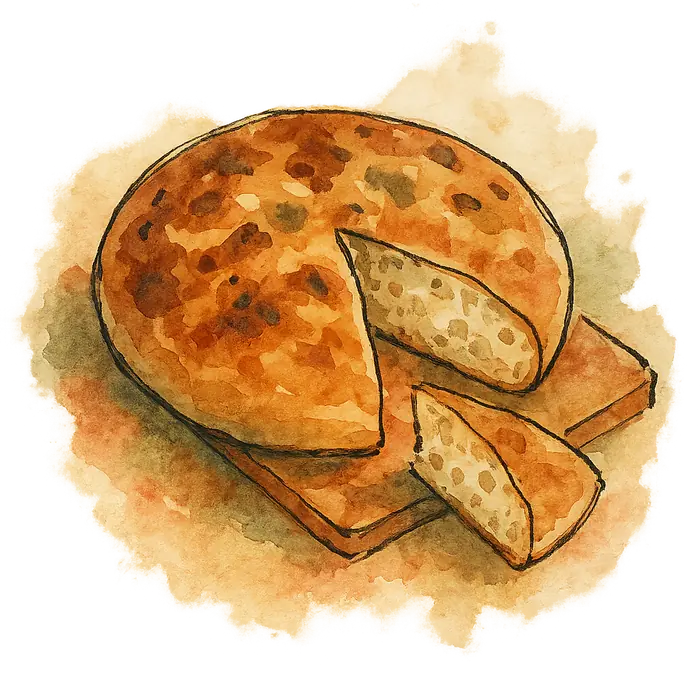
A watercolour of a round flat golden loaf with a blistered crust, one wedge cut away showing an open crumb
Generated with OpenAI gpt-image-1
Adapted from Pan-cooked yeasted flatbreads

Yeasted pan bread

An established dish converted to shelf-stable ingredients. Every substitution is documented below.

How long it keeps

About 6 months, set by Plain flour.

Indicative, for planning a build before you buy. The answer for a pack you already own is the best before date printed on it, and that only holds if it has been stored as the label says.

Serves
4
Burners
1
Pans
1
Water
0.5 L
Active
20 min
Total
110 min

Ingredients

Bread without an oven, from four things that all keep for a year.

Yeast wants warmth, not heat. Water that feels pleasantly warm on the inside of your wrist is right, roughly blood temperature. Hot water kills it and you will not know until an hour later when nothing has happened.

  1. Flour, salt, sugar and yeast in a bowl, salt and yeast on opposite sides until the water goes in. Direct contact with salt is hard on yeast.
  2. About 260 ml of warm water and the oil, mixed to a shaggy mass, then kneaded on any clean surface for five minutes. It will start sticky and stop being sticky, which is how you know it is done.
  3. Covered, somewhere warm, until doubled. An hour in a kitchen, longer in a van in March. Go by the size, not the clock.
  4. Knocked back, shaped into a round, and rested twenty minutes in the cold pan.
  5. Lid on, lowest possible flame, 15 minutes. Flip it with two hands or a plate, lid back on, 12 minutes more.

It is done when it sounds hollow tapped underneath. A heat diffuser under the pan makes this much easier and is the difference between a pale loaf and a burnt base.

Do not taste the dough. Flour is a raw agricultural product and has been linked to outbreaks of illness: see raw flour. Cooked through, it is fine.

Makes one loaf, about 4 servings.

What this was adapted from

Pan-cooked yeasted flatbreads: the covered-skillet method used where an oven is not available

  • an oven at 230 degrees → a heavy pan with a lid over a low flame

    An oven surrounds the loaf with dry heat and gives it a crust all over. A covered pan heats from below and steams from above, so the bread rises well, browns on two faces and stays paler round the sides. It is a flatter, softer loaf and it is genuinely bread rather than a flatbread.

  • strong bread flour → plain flour

    Strong flour has more protein and gives a chewier, more open crumb. Plain flour is what most cupboards actually hold, and it makes a softer, shorter loaf that is perfectly good. If you have strong flour, use it and expect a better one.